

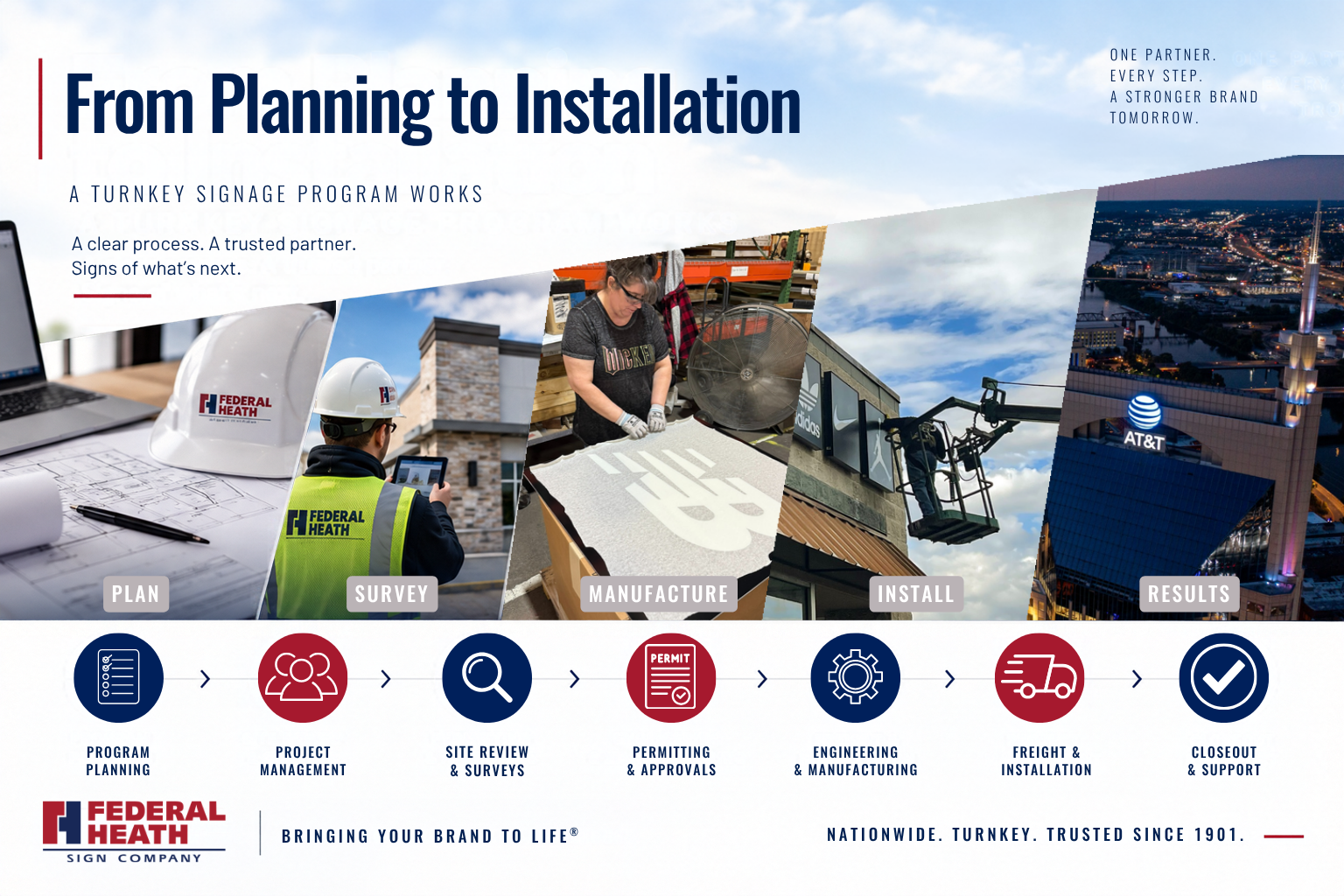
From Planning to Installation: How a Turnkey Signage Program Works
How does a national multi-location signage rollout work?
A national multi-location signage rollout begins by prioritizing locations, then moves through site surveys, code checks, customer approvals, permitting, manufacturing, shipping, installation, and closeout. Federal Heath coordinates those stages through project management while the customer sets priorities and approves each site’s scope before work advances.
Why a multi-location rollout needs a coordinated process
Every location can bring different site conditions, sign codes, landlord requirements, permitting processes, construction schedules, and installation considerations. When dozens—or even hundreds—of locations are involved, keeping those moving pieces coordinated becomes even more important. Federal Heath’s turnkey approach brings services such as surveys, code research, engineering, permitting, manufacturing, logistics, installation, and closeout together through a centralized project-management structure.
So, what does the process look like?
While every program is different, understanding the key stages can help your team prepare for a smoother rollout from initial planning through installation.
1. Start With the Right Information
A successful signage program starts with understanding the scope.
Early in the process, your signage partner may need information such as:
- Location lists and addresses
- Brand standards and sign specifications
- Architectural elevations and site plans
- Existing signage information
- Landlord requirements
- Construction or remodel schedules
- Priority locations and target completion dates
Not every detail will be available on day one—and that is okay. The goal is to establish what is known, identify what is missing, and determine what information needs to be gathered before individual locations move forward.
For multi-site programs, establishing this foundation also helps create a repeatable process that can be applied as additional locations are released.
2. Review Site Requirements and Sign Codes
What works at one location may not work at another.
Municipal sign codes can influence allowable sign size, placement, illumination, setbacks, mounting methods, and square footage. Landlord requirements and existing building conditions can introduce additional considerations.
Reviewing these requirements early helps the project team understand what may be possible at each site before moving too far into design or production.
This is also where communication between the customer and signage partner becomes important. If a code requirement affects the desired sign package, the team can discuss alternatives and determine the appropriate path forward before unnecessary time or resources are spent.
3. Prioritize Locations
Not every site in a multi-location program must move forward at the same time.
Some organizations begin with a specific market, group of priority locations, or smaller initial rollout before expanding the program. Others may prioritize sites according to remodel schedules, lease requirements, new openings, existing sign conditions, or other business needs.
Establishing those priorities gives everyone a clearer roadmap.
For larger programs, this phased approach can also help create a repeatable workflow before additional locations enter the pipeline.
4. Authorize Site Surveys
Once locations have been identified, field surveys help turn assumptions into site-specific information.
A survey can document existing conditions, measurements, electrical requirements, mounting conditions, access considerations, and other details needed to properly develop the signage solution.
This information becomes particularly important in multi-site programs because seemingly similar buildings can have very different field conditions.
Accurate site information early in the process can help reduce the potential for redesigns, change orders, installation complications, and other surprises later.
5. Develop and Approve the Proposal
With site information in hand, the signage partner can develop a more complete scope and proposal for each location.
Depending on the program, a proposal may account for more than the signs themselves. Engineering, permitting, freight, installation equipment, electrical requirements, inspections, and other project needs may also be part of the overall scope.
This stage gives the customer an opportunity to review the recommended solution, confirm the scope, ask questions, and approve the location before the solution moves into execution.
For multi-site programs, having a consistent approval process can help keep individual locations moving without losing visibility across the larger rollout.
6. Move From Approval to Execution
Customer approval is an important milestone, but there is often still work to be completed before manufacturing begins.
Depending on the project, the next phase can include:
-
Permitting and drawings. Permit applications, engineering, drawings, revisions, landlord requirements, or municipal approvals may need to be completed.
-
Product procurement. Materials, lighting components, specialty products, or other items may need to be sourced.
-
Production planning. Approved projects are coordinated with manufacturing schedules and other program requirements.
Because permitting requirements vary by jurisdiction, timelines can differ significantly from one location to another. The ability to track each site individually while managing the program becomes especially valuable at this stage.
7. Manufacture the Signage
Once the necessary approvals and requirements are in place, the project moves into manufacturing.
For a multi-location brand, manufacturing is about more than producing an individual sign. The signage should consistently represent the brand from one location to the next—even when site conditions require different sizes, configurations, or installation methods.
A national signage program, therefore, requires a balance between brand consistency and site-specific execution.
A repeatable manufacturing and quality-control process helps maintain those standards while supporting rollout schedules across multiple locations.
8. Coordinate Freight and Installation
Installation is when months of planning become visible on-site.
Before crews arrive, there may be freight coordination, equipment scheduling, site access requirements, construction coordination, electrical work, and other logistics to manage.
For an active business, installation may also need to be coordinated around operating hours or other on-site activities.
A turnkey signage partner helps coordinate these details, so the customer does not have to independently manage manufacturers, freight providers, installers, and other resources for every location.
9. Complete Project Closeout
Installation does not necessarily mean the project is finished.
Closeout may include completion photos, inspections, punch-list items, documentation, invoicing, and other final requirements. Turnkey signage services can also extend beyond installation to warranty support, maintenance, and repair.
For a multi-site program, consistent closeout procedures provide the customer with confirmation that each location has reached completion while maintaining an accurate picture of the overall rollout.
Communication Connects Every Stage
Although a signage program can be shown as a series of steps, communication should not be treated as just another step in the process.
It connects all of them.
Customers need visibility into what has been approved, what is waiting for information, where permits stand, what is in production, which installations are scheduled, and what has been completed.
Federal Heath’s News & Insights content emphasizes communication and project management as important elements of national signage programs, particularly as the number of locations and stakeholders increases.
Establishing expectations for reporting, responsibilities, approvals, and communication cadence at the beginning of a program can help both teams stay aligned as projects progress.
A Turnkey Approach Brings the Pieces Together
The value of a turnkey signage program is not simply having multiple services available. It is having those services work together.
Surveys inform proposals. Code research influences design. Approval leads to permitting and production. Manufacturing connects with freight and installation. Project management and communication provide continuity throughout the process.
Instead of coordinating multiple unrelated vendors independently, customers can work through a centralized program structure from initial planning through installation and closeout.
Whether the program begins with a handful of priority locations or involves a larger multi-market rollout, a defined process provides a framework that can scale to the customer’s needs.
At Federal Heath, we help national and multi-location brands manage the many moving parts of signage programs—from initial site information and surveys through permitting, manufacturing, installation, and ongoing support.
Planning a signage program? Contact Federal Heath to discuss your locations, priorities, and program needs.