
2 min read

ISA Working To Prevent Lighting Restrictions On Signs

Sign Lighting: Balancing Business Visibility and Responsible Illumination

Illuminated signs help customers recognize businesses and find their destinations after dark. When planning new signage or updating an existing location, businesses also need to consider how lighting interacts with neighboring properties and the surrounding environment.

The goal is effective illumination: a sign that communicates clearly while accounting for site conditions, applicable requirements, and responsible lighting practices.

Why Sign Lighting Needs Its Own Consideration

Sign illumination serves a different purpose from lighting a parking lot or building exterior. An internally illuminated sign lights its message from within, while general outdoor lighting typically projects light onto another surface.

The International Sign Association’s position on sign lighting emphasizes that standards should recognize these differences. Sign dimensions, construction, face materials, and light sources can all affect performance.

For business owners, this means lighting decisions should be part of the signage design process. Selecting a light source alone does not establish whether the finished sign will be readable or appropriate for its location.

Consider Visibility and the Surrounding Environment

A sign should be easy to recognize without creating unnecessary glare or directing light where it is not needed. The surrounding brightness, viewing distance, sign placement, and nearby properties all deserve consideration.

DarkSky International’s principles for responsible outdoor lighting encourage purposeful lighting, careful direction, appropriate light levels, and controls.

These principles provide useful context for project discussions. They do not replace the requirements that apply to a particular sign or property.

Ask the Right Questions Before Production

Before approving an illuminated sign, work with your signage partner to establish what needs to be reviewed:

  • What illumination requirements apply at this location?
  • Are there landlord or property-specific criteria?
  • How will the sign appear from the main customer approaches?
  • Could the lighting affect nearby properties?
  • Are operating-hour controls or dimming appropriate and compatible with the proposed equipment?

Resolving these questions early helps your team make informed decisions before manufacturing and installation.

Plan for Differences Across Locations

A national brand may use consistent logos and colors while encountering different site conditions and local requirements. A lighting approach suited to one property may need adjustment at another.

For multi-location programs, document approved specifications alongside any site-specific adaptations. Keep design decisions, approval requirements, and production information connected so each location reflects the brand within its project constraints.

Federal Heath’s project management services help coordinate site reviews, approvals, permitting, manufacturing, and installation.

Review Performance After Installation

Include an evening review in your signage evaluation. Check readability from customer approaches, look for uneven illumination, and confirm that any controls operate as intended.

Continue inspecting the sign over time so lighting failures or damaged components can be addressed.

Whether you are planning a new location or refreshing an existing program, Federal Heath can help connect your brand goals with practical signage planning. Explore our signage solutions to learn more.

Original industry update: This article was originally published in 2014 to highlight ISA’s advocacy regarding sign lighting restrictions. View the original ISA industry news link.

How Can Businesses Make Parking Lots Safer After Dark?

Learn how to fix dark parking lots and help customers see their surroundings, recognize your business, and follow a safe, clear route to the entrance.

Read More

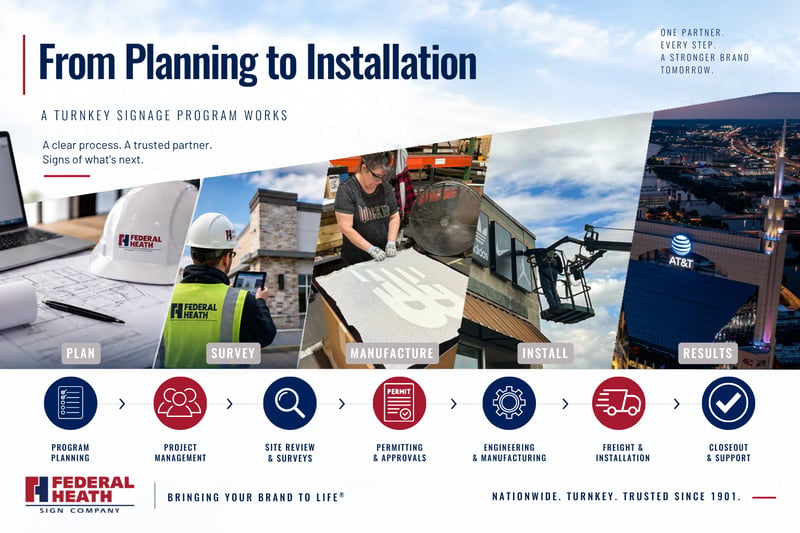
From Planning to Installation: How a Turnkey Signage Program Works

Learn how a turnkey signage program moves from planning and site surveys through permitting, manufacturing, installation, and project closeout.

Read More

7 Questions Restaurant Chains Should Ask a National Signage Partner

Discover seven questions restaurant chains should ask a national signage partner before a multi-location rollout, from permitting to maintenance.
Read More